Selected works
Deep neural network for evolution equations
Evolution equations differ fundamentally from elliptic problems in that their solutions possess a propagation (or causality) property: the state at a later time is determined by, and depends on, the state at earlier times. In addition, the solution may develop strong temporal heterogeneity, e.g., concentrating on different spatial regions as time evolves. These features can make learning-based solvers and physics-informed training unstable, since errors may accumulate along the time direction and the relevant solution features may shift over time.
To mitigate these difficulties, we propose three complementary approaches:
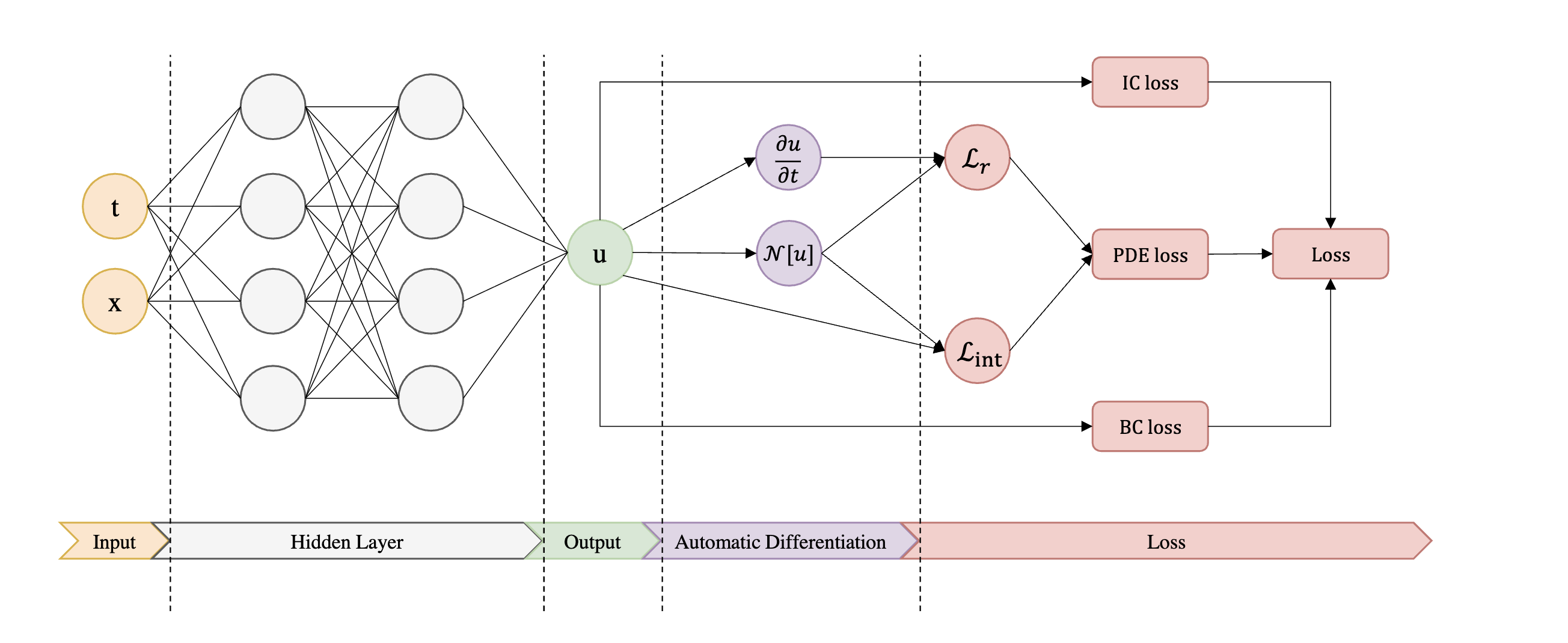
- Time-simple hypothesis space with exact temporal integration: we adopt a simple hypothesis space in the time variable and evaluate integrals along the time direction using accurate Gaussian quadrature, so that the temporal contributions are treated in a controlled and numerically reliable manner.
- Integral regularization in the training objective: we modify the loss function by adding an integral regularization term that enforces consistency over time and improves stability, thereby reducing error accumulation and enhancing generalization across the full time horizon.
- Causal–integral neural architecture: we design a causal–integral network structure that explicitly respects temporal causality and incorporates integral information, enabling the model to better capture the propagation dynamics inherent to evolution equations.